Asianart.com | Associations | Articles | Exhibitions | Galleries


Visitors' Forum

Asian Art  Forums - Detail List
Asian Art Forums

Message Listing by Date:
Message Index | Back | Post a New Message | Search | Private Mail | FAQ
Subject:translation chinese tekst
Posted By: Alex Wed, Nov 04, 2026 IP: 77.171.6.146

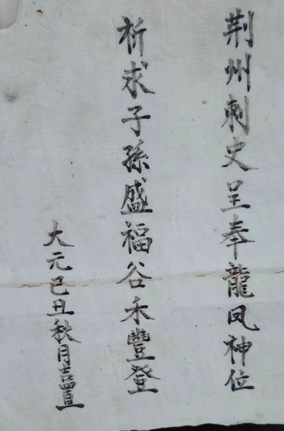
Dear Mr. Nagy, can you translate this chinese tekst?


Subject:Re: translation chinese tekst
Posted By: I.Nagy Thu, Nov 05, 2026

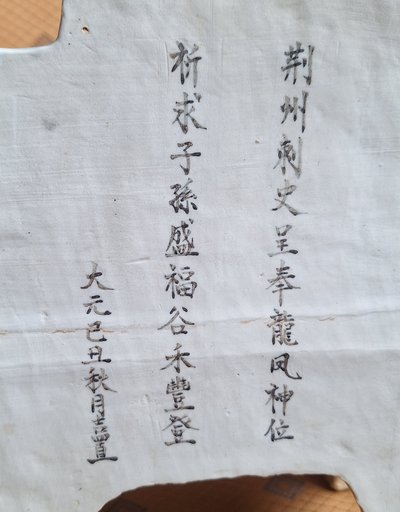
荊州刺史呈奉龍凤神位
祈求子孫盛福谷禾豊登
大元巳丑秋月吉置

The Prefect of Jing Province respectfully presents this Dragon and Phoenix Tablet,
Praying for abundant blessings for his descendants, prosperous fortune, and bountiful harvests of grain and a prosperous reign.
Auspiciously placed in the Autumn Month of the Year of the Great Yuan Dynasty (1289)

With regards,
I.Nagy

Subject:Re: translation chinese tekst
Posted By: Alex Thu, Nov 05, 2026

Oke thank you for the translation. do you know of any porcelain examples in the palace museum that bare this tekst?

Subject:Re: translation chinese tekst
Posted By: I.Nagy Sat, Nov 07, 2026

The response from China's Baidu AI to your question:
"The currently available catalogues of Yuan Dynasty porcelain from the Palace Museum do not include any artifacts bearing inscriptions such as "Prefect of Jing Province" "Dragon and Phoenix Tablet" or "Abundant Harvest". No official museum records were found to support this information"

As a user of Chinese language, I have only two comments to make regarding the inscription. The character 凤 in the first line is the modern form adopted after the writing reform (orig. 鳳), even if we disregard it as the writer’s personal habit to use the cursive style, the character 谷 in the second line (orig. 穀) is clearly the result of the character simplification announced in 1955.
When copying original texts, it is not customary to rewrite the originals using modern simplified characters.

With regards,
I.Nagy


Subject:Re: translation chinese tekst
Posted By: Alex Sat, Nov 07, 2026

For the second carater AI says this

AI Overview
The Chinese character for "valley" (or gorge/ravine)—which was used during the Yuan dynasty (1271–1368) and throughout the entirety of classical Chinese history—is:

谷 (pinyin: gǔ)
HanziHero

Characteristics of the character

Meaning: Valley, gorge, ravine; also used to refer to grain.
Form: The character has remained unchanged throughout the transition from classical to modern Chinese (it is identical in both traditional and simplified Chinese).
Radical: It serves as Radical 150 (the "valley" radical) in traditional Kangxi-style dictionaries.

Subject:Re: translation chinese tekst
Posted By: I.Nagy Sun, Nov 08, 2026

Yes, the AI is correct in stating that the character 谷 (gŭ), meaning “valley,” has not changed in form at all from the Yuán dynasty to the present day. However, it does not clearly mention that, as part of the 1955 writing reform, some traditional characters were replaced with characters that have fewer strokes but the same pronunciation. The character 穀 (gŭ)“cereal,grain, millet" was included in this so-called “homophonically simplified” group and replaced with character 谷 (gŭ) "valley".
Therefore, 五谷 wŭgŭ (orig. 五穀) does not mean “five valleys,” but rather “five grains" (rice, two kinds of millet, wheat, and beans). or
打谷 dăgŭ (orig. 打穀)does not mean "hit the valley", but rather "tresh crops" etc.

To that, the AI simply says, "Meaning: Valley, gorge, ravine; also used to refer to grain"

I think the above might be a little difficult for an outsider to understand.

With regards,
I.Nagy


Subject:Re: translation chinese tekst
Posted By: Alex Sat, Nov 07, 2026

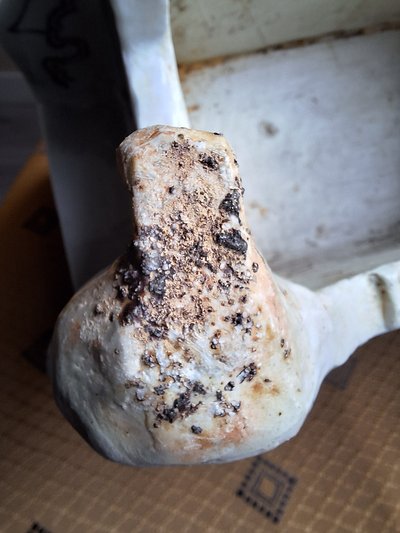
Dear Mr. Nagy, i do not see the caracter you mentioned in the beginning of the first line. And it is strange if the object would be modern because the feet of the item have origenal old kiln grit on them.


Subject:Re: translation chinese tekst
Posted By: I.Nagy Sun, Nov 08, 2026

Dear Alex,

In Chinese vertical writing, the text begins at the top of the right-hand line and ends at the bottom of the left-hand line.
Thus, the character in question, 凤, is the 8th character from the top in the first line.

As of your question about the originality.In modern-day China and elsewhere, the techniques used to create copies and fakes are extremely sophisticated. While the presence of sand (grit) from an old kiln on the foot of a piece was once considered a criterion for authenticity, it is now widely recognized as a typical method of deception used to make a piece appear genuine.
Furthermore,the white body and the surface condition of the tablet also lack the weathering characteristics typical of antique ceramics that have endured for centuries.It retains the uniformity and sense of artificiality characteristic of items made with modern, refined clay and firing techniques.
In addition,looking at the photo, the lines of this inscription lack the natural variations in pressure, the flexing of the brush hairs, and characteristics such as “bleeding” and “fading” typically associated with brush calligraphy, leaving me with several strong reservations.

Regards,
I.Nagy

Subject:Re: translation chinese tekst
Posted By: Alex Sun, Nov 08, 2026

thanks for all the info and ai confirms it. Well at least it is a pretty decorative curio object.

Subject:Re: translation chinese tekst
Posted By: Alex Sat, Nov 07, 2026

The simplified character 凤 was officially standardized in 1956 during the People's Republic of China era. However, its abbreviated shape existed informally in handwriting for centuries prior, including during the Yuan dynasty.
• Official Standard Use (1956–Present): The government of the People's Republic of China formally introduced 凤 as the standard replacement for 鳳 in the Chinese Character Simplification Scheme to boost literacy. (Note: The second character, 凰, was never simplified and remains the same in both systems).
• Informal Historical Use (Tang through Qing Dynasties): The modern simplified form 凤 was modeled after centuries-old cursive script (caoshu) and popular "vulgar" shorthand (suzi). Calligraphers, scribes, and merchants regularly used this abbreviated form in personal letters, ledgers, and drafts long before the 20th century, though 鳳 remained the required standard for official Yuan dynasty documents, imperial decrees, and formal inscriptions.


Asianart.com | Associations | Articles | Exhibitions | Galleries |