Asianart.com | Associations | Articles | Exhibitions | Galleries


Visitors' Forum

Asian Art  Forums - Detail List
Asian Art Forums

Message Listing by Date:
Message Index | Back | Post a New Message | Search | Private Mail | FAQ
Subject:poem on edo advertising print
Posted By: francis minvielle Fri, Jun 26, 2026 IP: 82.226.118.25

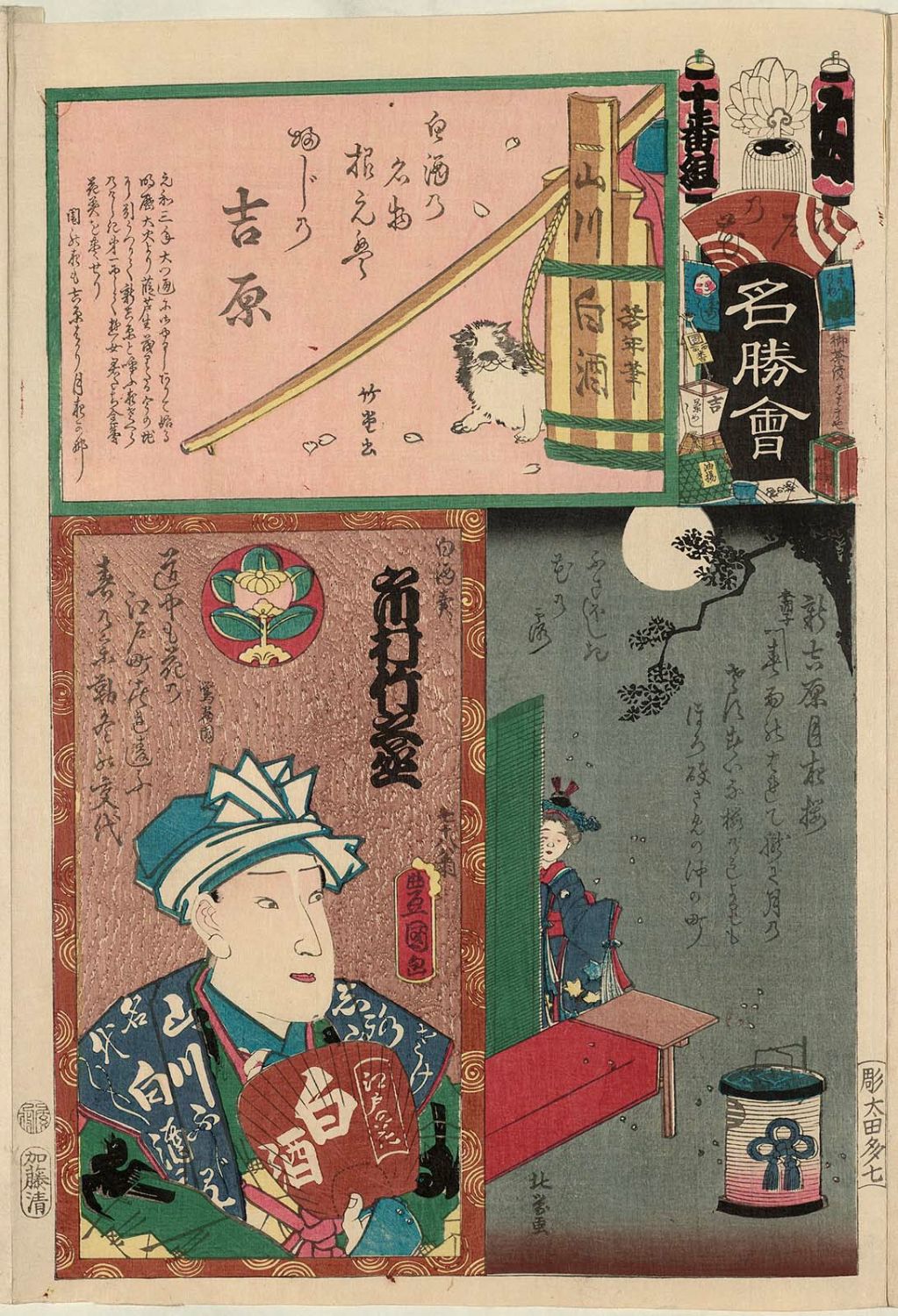
please translate the text in the black cartouche and the poem


Subject:Re: poem on edo advertising print
Posted By: Stan Fri, Jun 26, 2026

Here is the description of this print from the Artelino (www.artelino.com) site:

From the series "Edo no hana - Meisho-e" (Flowers of Edo: A Compilation of Beautiful Places).

Top Inset: A puppy and a bucket of "Yamakawa Shirozake". Yoshiwara. By Yoshitoshi.

Lower Right Inset: Cherry blossoms at Yoshiwara in a moonlit night. By Hokuto?

Lower Left Inset: Kabuki Actor Ichikawa Takenojo V as "Shirozake uri" (vendor of sweet white wine). By Kunisada.

The term “flowers of Edo” (Edo no hana) can refer, among other things, to fires. The title panel for each print in this series shows the lanterns and identifying standard (matoi) for one of the brigades of firefighters (hikeshi) assigned to various districts. (Excerpt from MFAB).

The series was planned for 100 prints introducing the best and famous places or things of Edo. The series was prematurely ended due to the death of Kunisada, but still, quite remarkable for the largest collaboration of artists, total 21, in the long history of ukiyo-e.

This series is in the William Sturgis Bigelow Collection of the Museum of Fine Arts Boston.

Cheers,
Stan

Subject:Re: poem on edo advertising print
Posted By: Horst Graebner Fri, Jun 26, 2026

No advertising print!
Even though the texts aren't transcribed here (https://collections.mfa.org/objects/476470 ), you can find information about the print here.
And what exactly is the point of your "make-work scheme" supposed to be!?

Subject:Re: poem on edo advertising print
Posted By: francis minvielle Sat, Jun 27, 2026

Thank you for your reply. I agree this series is not for advertisement, but I understand a number of prints from this series were commissioned by merchants to show their products.
I did not mention "make-work scheme" in my message at all. So i don't understand where you got it from.
Cheers,
Francis

Subject:Re: poem on edo advertising print
Posted By: I.Nagy Sat, Jun 27, 2026

What was left out of the aboves.

Top,
Lantern,
十番組 Brigade No.10

Uppercase inscription,
白酒の名物根元はふじの吉原
The origin of the famous shirozake; Fujino Yoshiwara

Longer text on the left,
It was founded in the 3rd year of Genwa (1617),by official permission on the Omon-dori. Following the Great Fire of Meireki (1657), the district moved to this present site - where reeds had sprung up - and was named Shin-Yoshiwara. The sight of the night blooming cherry blossoms was unparalelled, and the courtesans displayed the full splendor of their beauty at the height of their glory. Even in the dark night Yoshiwara thrieved - what a moonlit night it was.

Lower left,
道中も花の江戸町すれ違ふ春の参勤冬の交
Along the way in the flower filled town of Edo the alternate attendance is performed from winter to spring
(An interesting turn of phrase that refers to the "sankinkotai" system of the Edo period)

Regards,
I.Nagy

Subject:Re: poem on edo advertising print
Posted By: francis minvielle Mon, Jun 29, 2026

does "fuji no yoshiwara" refer to the sake origin or to the pleasure district, or is it a play with words beteween the two readings?

Subject:Re: poem on edo advertising print
Posted By: I.Nagy Tue, Jun 30, 2026

A Japanese-language explanation, I found online regarding the origin of the name of the shirozake called Fujino Yoshiwara says,that "This is a famous white sake that was sold at Motoichiba, located on the west side of Yoshiwara-juku (present-day Fuji City, Shizuoka Prefecture) on the Tōkaidō road. During the Edo period, it was widely known as "Fuji no Shirozake" or "Yamakawa Shirozake," which was produced in this area"
According to another source, it can also be derived from the Fujino (藤野 family name. Since it is always written with the kanas “ふじの", so it may refer to "Fujino's Shirozake" or the "Shirozake of Mount Fuji"
So it goes without saying—if only because of the name—that this sake was also popular in Yoshiwara, Edo.

With regrds,
I.Nagy


Asianart.com | Associations | Articles | Exhibitions | Galleries |