|
Subject:Re: namazu-e right file
Posted By: MichaelO Thu, May 07, 2026
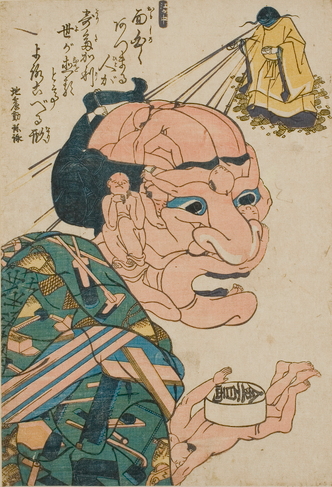
This is a print created in response to the Ansei earthquake in 1855. It is a catfish print, namazu-e.
The print is based upon an earlier (1840’s) Kuniyoshi woodblock print, often illustrated, which can be found here:
https://ukiyoe.univie.ac.at/en/fullview.html?lang=e&docid=451
A transcription of the poem on your print can be found on Honkoku here:
https://app.honkoku.org/transcription/DBCFCDF10035B3D4FF61F80C1FC49AD7/1
The print is discussed in the Master’s Thesis “Study of the Ansei Earthquake Wood-Block Prints in the Royal Ontario Museum” by Hidemi Shiga (2004) at pps 141-142.
Ms. Shiga describes the print this way:
“This style of pictorial representation, using human bodies to form a face and figure of an individual was pioneered by the famous printmaker, Utagawa Kuniyoshi (1797 - 1861) and became a popular compositional technique. The pattern on the figure’s kimono incorporates the tools of the building trades. Note that the depiction of the namazu in this print is as a Shinto god emitting divine light implying that the namazu has magically produced the wealth in the worker’s hand.”
The package in the hands of the figure depicted in the print is a paper wrapped package of gold coins. I believe the package is labelled gold coins. 金 小判
Furthermore, Ms. Shiga translates the text on the print as follows:
“Translation:
[Seal]
Throughout Edo
[poem]
Commoners gathered excitedly, showing their happiness in the face.
It is the form of social mending.
A remarkable record of a movement caused by the earthquake”
Ms. Shiga notes: 珍 “Face” “can be read either as nari the verb “to be” or as kata “face,”
“form,” or “figure.” This doubled meaning produces the sense that the people of Edo are happy so they formed a face.”
I attach a photo of Ms. Shiga’s transcription of the text on the print below.
Hope this helps.


|
 namazu-e right file
  ( China & Japan ) - francis minvielle - May 06, 2026 (04:52 AM)