Articles by Dr. Pratapaditya Pal
A Painted Book Cover from Ancient Kashmir
by Pratapaditya Pal[Dedicated to the memory of Lobsang Lhalungpa (1924 – 2008) who taught me Tibetan in Darjeeling years ago.]
text and photos © Pratapaditya Pal and image copyright holders
(click on the small image for full screen image with captions)
1
The history of architecture and sculpture from Kashmir’s pre-Islamic past (1st c. BCE – 1300 CE) is well-apprised but nothing is known about painting. No example of pictorial art has yet come to light in the Valley of Kashmir. The sculptures were created for both Hindu and Buddhist faiths in all the principal media — stone, metal, terracotta and wood [1] — and we must assume the art of painting was familiar as well. As is the case elsewhere on the Indian subcontinent, there must have been murals, illuminated manuscripts as well as patachitra or painting on cloth, the three principal forms of religious painting.
Although no actual specimen has survived in the Valley, there is sufficient literary and circumstantial evidence to make a strong case for the existence of painting in Kashmir during the ancient period. The literary evidence embedded in both sacred and secular texts have been discussed elsewhere and need not be repeated here.[2] Suffice it to say that the most ancient surviving discourse on the art of painting in the Sanskrit language by common scholarly consensus was compiled in Kashmir. This is the famous Chitrasutra of the Vishṇudharmottarapūraṇa, most likely redacted not later than the seventh century. It is the most comprehensive text on the theory and practice (as well as Brahmanical iconography) of the visual arts, particularly painting, that we have from ancient India. Apart from other passing allusions to pictures in the literary works by Kashmiri authors, it should also be remembered that the largest number of theologians and philosophers who have contributed to the study of Indian aesthetics were of Kashmiri origin. The greatest of them wa Abhinavagupta (late 10th – early 11th c.), a contemporary of the eminent Tibetan scholar-translator Rinchen Zangpo (958 – 1055), who has provided crucial circumstantial evidence for the existence of painting in Kashmir.
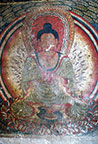
Fig. 1 Rinchen Zangpo’s biography informs us that this native of Guge and zealous champion of Buddhism was principally responsible for reviving the faith in Western Tibet. Not only did he visit Kashmir as a young man but on the completion of his studies returned to Guge with images, books and artists.[3] These were the artists who helped him build and adorn with sculptures and murals in the numerous temples and monasteries across the kingdom. At that time Guge included much land that is now part of the state of Himachal Pradesh of the Republic of India. The best known of these temples is Tapho or Tabo (founded in 996) but many other structures and caves in the region also attest to the artistic talent of those unknown Kashmiri masters (fig. 1).[4] These early murals of the Western Himalayas unequivocally demonstrate both the experience and skill of the thirtytwo Kashmiri artists recruited by the Tibetan monk. The work of these artists further corroborate the later Tibetan tradition that a school of art flourished in ancient Kashmir. That these murals must be regarded as expressions of the Kashmiri painting tradition can also be demonstrated by a comparison with the sculptures surviving in the Valley which clearly establish their stylistic, formal and iconographic kinship. Most scholars who have studied these murals have emphasized this direct connection.
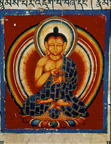
Fig. 2 The purpose of this article is to discuss a painted panel in wood that was introduced in the recent exhibition of the arts of Kashmir (fig. 5 below). This painted panel is the only known object of its type that can be clearly traced to Kashmir itself and the artists there. [5] It was not possible in the accompanying publication to discuss at length the historical and artistic implications of this object and hence the present discussion. Before we do so, however, let us briefly review the history of manuscript illumination in Western Tibet.
The earliest manuscripts illuminated by either Kashmiri artists, or in the distinctive Kashmiri style by Tibetans were acquired in Western Tibet and first published by Giuseppe Tucci (1894 – 1984), the eminent Italian scholar. These are now in the Los Angeles County Museum of Art (LACMA) and are well known in the scholarly world.[6] We illustrate here one example depicting Vairochana Buddha (fig. 2).
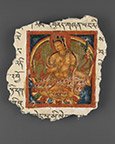
Fig. 3 In recent years more isolated Tibetan manuscript pages have come to light, which considerably enlarge our repertoire of this Kashmiri- or Khache-Tibetan school of painting.[7] They require a longer study than is possible here but a few unpublished examples are offered to set the stage, so to speak, for our presentation below of indisputable visual evidence of the art of painting in Kashmir proper. One of the manuscript pages portrays a bodhisattva (fig. 3) with a muscular body indicated by heavy shading characteristic of the plasticity typical of contemporaneous Kashmiri sculpture. The yellow complexion of his body is highlighted with orange-red. Wearing a dhoti enriched with a pattern of rows of alternating pink and blue deer with their heads turned uniformly to their left, he sits in elegant lalitāsana with his head turned to his right. The seat is a lotus with multi-hued petals and the figure is set off against a gold disc surrounded by a multi-hued border. The head with long black hair and adorned with a tiara is provided with a red nimbus. Apart from gold ornaments, he wears a red scarf which undulates playfully on both sides of his arms to augment the sense of movement of the lively composition. His right hand displays the gesture of exposition (vyakhyānamudrā) against his chest as it holds the rosary (akshamālā). It should be noted that the palm of the hand faces the body as is typical in Kashmiri images. With the left hand he grasps the stem of green foliage in which nestles a pot of the kuṇḍikā variety containing elixir (amṛita). Both these hand attributes make it clear that the figure represents the bodhisattva Maitreya. The composition is framed by a wide red border, the four corners inside the square being filled in with indigo pigment.

Fig. 4 Fig. 4 illustrates a dozen figures culled from various loose pages of several Tibetan manuscripts copied likely in the eleventh century. The group includes a wide variety of Buddhas and bodhisattvas that are interesting both for their iconographic variety and for their discrete stylistic characteristics that clearly reveal their Kashmiri kinship, if not origin. The figural forms, the modeling with strong emphasis on the heavily shaded bodies of both male and female bodhisattvas, the garments and the swirling scarves, the design of the aureoles and lotuses of bright multiple hues, are distinctive of Kashmiri style murals in Western Himalayan shrines as well as in Kashmiri sculptures. The solitary wrathful deity is particularly close in style to those seen in Kashmiri metal sculptures. Noteworthy also are the two distinctive styles of architecture reflecting timber construction that was prevalent in Kashmir and Western Himalayas and encountered in other manuscript illuminations as well. Three of the representations show Buddhas en face but with three different types of drapery, one of which is unusually blue. The fourth Buddha-like figure in the third row depicted with his head turned to the right has no cranial bump or ushnisha on his head and is likely to represent a deified monk.
These few illuminations are distinguished from both the East Indian and Nepali styles of manuscript illustrations not only by their distinctive figural forms and the use of shading but also by the luminous tonality, the intensity and the diversity of the colors, as well as the application of gold. Thus, there can be no doubt that the wealth of murals in Western Himalayan Buddhist temples and the surviving illuminations in Tibetan manuscripts recovered from the region together attest the existence of a discrete tradition of painting that bears a close stylistic kinship to the sculptures that have survived in the Valley and that both are expressive of the same aesthetic.
3
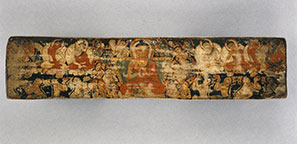
Fig. 5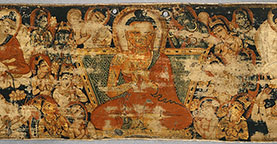
Fig. 6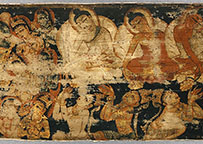
Fig. 7
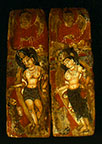
Fig. 8 The focus of this article is a narrow, rectangular panel that is 33 cm. long and 7.5 cm. high (figs. 5-7). However, it is clear that along the bottom it has been trimmed by a couple of centimeters, perhaps because it was damaged or worm-eaten. What is missing is a tiny section of the supplicating serpent-kings (nāgarāja) emerging from the waters. Almost certainly the panel served as a book cover as will be discussed below. If so, the manuscript would have been composed of birch bark as is the case with the Gilgit books.[8] The size of the book would have been larger than the Gilgit covers (see figs. 8 and 9). It should be noted further that the dimensions of the panel is quite different from those of the average covers of Eastern Indian and Nepali palm-leaf books—usually about 50 centimeters long and slightly narrower. The Gilgit covers are about 21 centimeters long.
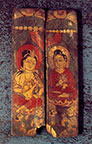
Fig. 9 The subject of this cover is the scene of the Buddha preaching to a diverse congregation of Buddhas and bodhisattvas, some mortals and adoring serpent-kings. The Buddha’s lotus rises from the ocean from which a group of nagarajas emerge on either side, each with a single snake rising like a tail. With their hands raised in the gesture of offering (añjalimudrā) the serpent-kings are a study in graceful expression of intense devotion. The four nearer the central Buddha are oriented towards him while four others at the two ends turn the other way. If the cover’s ends have not been trimmed then the number of nagarajas would be eight, symbolizing the eight directions, thereby emphasizing the cosmic dimensions of the space.
Seated in the classic posture of meditation the central Buddha is garbed in the conventional red robe of the monk. The triangular throne back of an inverted pyramidal shape has a gem-studded yellow border enclosing a background field of light green. Each diamond encloses a cross motif. The robe’s edge along the left shoulder has overlapping folds in green, also visible near the ankle of the right leg. The edge of the elegant folds below the left arm is outlined in freely drawn lively black trim, details that add volume to the garment. The sense of volume of the Buddha’s bare right arm, shoulders and chest as well as the face is enhanced by highlighting the pale yellow flesh with orange, as may be seen in the figural forms of the mid-eleventh century murals of Dukhang in Tabo (fig. 1). With his hands the Buddha expresses the gesture of preaching the Law (dharmachakrapravartanamudrā). Distinctive are the extremely narrow eyes emphasizing his trance-like gaze. The oval nimbus is bordered by a band of flames rendered in mauve.
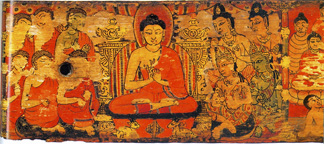
Fig. 10 The halo is flanked by a Buddha standing behind the throne back holding a flywhisk with his right hand and a lotus flower with the left. On the other side is a crowned bodhisattva of a dark green complexion, also with a flywhisk but in his left hand. The two figures behind this bodhisattva, one light and one dark may represent females. The corresponding couple on the other side are both given the dark grey-green complexion. Surrounding the Buddha are eight other figures, six of whom are crowned and bejeweled, while the two near the Buddha’s knees are monks. The one near the left knee is too effaced to see clearly, but the other has a beard. Beyond this group of adorers on the upper tier are seven larger seated Buddhas. Four on the left of the central Buddha can be clearly recognized. There may have been an eighth Buddha at the other end but the form is unclear. The four Buddhas closer to the preaching Buddha are oriented towards him, while the others are turning away. The serpent-kings below these Buddhas also follow the orientations of the Buddhas above. What is unusual is that some of the Buddhas hold lotus flowers with their right hands as if about to offer them to the Central Buddha.
It is possible that the edges of the cover have been slightly trimmed in the past, perhaps to smoothen the damaged edges. This is particularly suggested by the orientations of the serpent-kings at the two extremities. Almost certainly the text would have been written on birch bark, if indeed it served as a book cover. Birch bark was the preferred material in Kashmir. Of course, the million dollar question is: Where are all the Kashmiri manuscripts taken to Guge and elsewhere in Tibet by Rinchen Zangpo and other monks, both Kashmiri and Tibetan?
Be that as it may, the subject matter of this panel is radically different from most covers of Eastern India and Nepal, which belong generally to manuscripts of the several variants of the Prajñāpāramitā text. Usually they are filled with eight conventional scenes of the Buddha’s life, as may be seen in what constitutes the earliest example now in the Metropolitan Museum of Art, New York. Instead, on the Kashmiri panel, we see a generic theme of a Buddha preaching to a congregation, which often is the characteristic beginning of the typical Mahayana book.
Relevant for our understanding of the subject of the Kashmiri panel is the beginning of a sutra, preserved in the Chinese Buddhist canon, as follows: “Thus have I heard; once the Buddha dwelt in the monastic abode of the Blue Lotus Pond in the Markata (Monkey) Grove of the state of Vaiśāli.”[9] The passage then goes on to describe the large assembly of Buddhas and bodhisattvas, monks and lay worshipers who had gathered for the sermon. The Buddha first goes into a trance or samadhi and then seated on a “jeweled lotus blossom” along with others, he emerges from that trance and begins the discourse with “a subtle smile of radiant harmony” illuminating his “full-moon-like face.”
It should be noted that the Gilgit finds of 1931 included the only manuscript of the Bhaishajyaguru sūtra copied during the reign of the Paṭola Shāhi monarch Surendra Vikramāditya Nandi in the early years of the 7th century just before the arrival of the Chinese pilgrim Xuanzang in the region. Moreover, the text quoted above and others of the Healing Buddha (Bhaishajyaguru) cycle are believed to have been composed in the Kashmir region and most of the monks responsible for their transmission and translation were associated with Kashmir as was the famous Kumarajiva (4th c.), the translator of the Lotus Sutra.[10] Thus, it would not be farfetched to conclude that if this painted panel did indeed serve as a book cover, the text could have been one of the Healing Buddha cycle, such as the "Sutra Spoken by the Buddha on the Contemplation of the Two Bodhisattvas, King of Healing and Supreme Healer, expounded in the Blue Lotus Pond in Vaishali.”[11]
To return to the matter of the style of the painting. It is clear from even a casual comparison with the Metropolitan cover (fig. 9) that the two differ significantly.
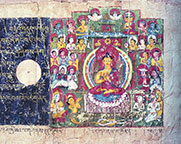
Fig. 11 Moreover, I have argued elsewhere[12] that the style of the figures on the panel is close to those at Tabo, especially in the delineation of the forms and the mode of shading, which indicate that it belongs to the Kashmiri Buddhist pictorial tradition. Thematically relevant representations of such scenes of preaching a Buddha may be seen in a Prajñāpāramitā manuscript in the Poo monastery in Himachal Pradesh [13] (fig. 11), the magnificent murals of the eleventh century in an eclectic style in the Dritsangkhang at Drathan Gonpa near Lhasa in Central Tibet [14] and the recently discovered murals at Nyang Lakhang (fig. 12). The scene on the panel under discussion, however, differs significantly in the composition and arrangement of figures from all the others, in the diversity of the audience, the overall composition, the groupings of the figures, the modeling and coloring, the postures and gestures, and in several other ways. Especially noteworthy here is the cluster of figures immediately around the central Buddha, the presence of fewer monks and the importance given to the other Buddhas as well as the serpent-kings. Their body language, much more nuanced than is generally the case, express their devotional ardour with remarkable acuity. Ultimately such scenes derive thematically from the crowded compositions of preaching Buddhas in Gandhara stone reliefs, but the arrangement on the panel is more fluid and less compartmentalized. The figures here express more verve and energy, thereby resulting in an elegantly lively composition.
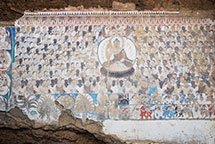
Fig. 12 As Martin Lerner [15] has suggested the Met cover bears strong stylistic kinship to the Ajanta paintings (fig. 13), though the possibility of a Nepali origin cannot be ruled out. In any event, I concur with Lerner’s comment that the Met cover represents the missing link between the earlier Indian tradition, as represented at such sites at Ajanta and Ellora, and the Pala period manuscript illuminations, of which the 1015 C.E. Nepali manuscript in the Cambridge University Library is the earliest dated example.[16] The Metropolitan cover is also certainly earlier than the Mahipala I (c. 988 – 1038) period illuminated manuscript in the Los Angeles County Museum of Art.[17] Thus, a 10th century date is undoubtedly acceptable for the Metropolitan cover, though Lerner’s suggested date of 9th century is not improbable.
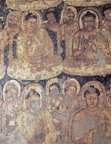
Fig. 13
The tenth century is almost certainly the likely date for the Kashmiri panel or book cover discussed here, but a late ninth century date cannot be ruled out altogether. Indeed, the C-14 test results of the cover does confirm a date range of 879 CE to 1024 CE at 100%, the most likely figure being 855 +/- 45. Thus, a date around ca. 900 for the cover seems to be corroborated both by stylistic and scientific evidence.[18]
Conclusion
As has been the case with Kashmiri Buddhist metal images, most of which have appeared in the art market in the second half of the 20th century, largely due to the destruction of Tibetan monasteries following Chinese occupation, this Buddhist book cover has also emerged from Tibet. So one may wonder if this too was painted in Western Tibet by a Kashmiri painter or in Kashmir proper. If the date of the cover suggested here—early rather than the late tenth century—is accepted, then we must conclude
that it was painted in Kashmir and then taken to Tibet. It is unlikely
that any Buddhist manuscript would have been prepared in Western Tibet
before the time of Rinchen Zangpo. Secondly, it differs significantly
from the style observed in eleventh-twelfth century manuscripts like
the Los Angeles pages (fig. 2) or the more recently found illuminations
(fig. 3). The style here is definitely Indian but differs distinctly
from those of Eastern India or Nepal, or for that matter the Metropolitan
cover (fig. 10), which is an early example from either India or Nepal.
Moreover, to date no painted book cover has been found in Western Tibet,
where the practice seems to have been to illuminate only the pages,
whereas among the Gilgit manuscripts only the covers were painted. With
the exception of the Metropolitan cover—whether painted in Nepal
or India—all evidence at present indicates that in both regions,
as well as in Central Tibet, the practice was to illuminate the pages
with scenes from the life of the Buddha or images of deities. Neither
from Nepal nor Eastern India do we have painted covers earlier than
ca. 1100. Thus, the painted panel or cover with the scene of the Buddha
preaching before a celestial audience must have been painted in Kashmir
rather than in Western Tibet by Kashmiri artists or their Tibetan pupils.
Could this exquisitely painted wood panel have served as a sutra cover acquired locally by the young Rinchen Zangpo during his first visit to Kashmir, perhaps as a gift from his revered teacher Śraddhākaravarman? Or was the manuscript brought to Tibet by one of the many traveling Kashmiri monks who played a prominent role from as early as the seventh century in disseminating their faith to Tibet?
Such questions for the present must remain unanswered but the discovery of the book cover discussed here offers compelling evidence for the history of painting in ancient Kashmir. Along with the Metropolitan book cover, this is yet another example of a tenth century, if not earlier, book cover that narrows the gap between the Gilgit covers and the tradition of book illumination that took off in the early eleventh century in Eastern India and Nepal. And if both covers have emerged from Tibet, then the importance of that country for the understanding of our knowledge of Indian Buddhism and the art that the faith inspired cannot be overemphasized.
Notes
- Although no actual specimen of wood sculpture of the ancient period has survived circumstantial evidence indicates that wood was once a popular medium. Beside indirect and literary evidence, a great deal of woodcarving has survived from Ladakh and Himachal Pradesh. For examples of ca. 1000 CE wood carvings by Kashmiri artists at Kojarnath in Guge, see Neuman, Helmut F. and Heidi A. Neumann, “The Portal of Khojar Monastery in West Tibet.” Orientations, vol. 39, no. 6 (September 2008), pp. 62-73.
- See Pal, Pratapaditya, et. al. The Arts of Kashmir (New York: Asia Society, 2007), chapter on painting.
- Snellgrove, David L. and Tadeusz Skorupski. The Cultural Heritage of Ladakh, vol. 2 (Warminster, Wilts: Aris and Philips, 1980), pp. 83-116; Tucci, Giuseppe. Indo-Tibetica, vol. 2. Rome: Reale Academia D’Italia, 1933.
- For one of the latest discoveries see Pritzker, Thomas J. “The Wall Paintings in the Dukhang of Tabo” in Singer and Denwood, pp. 150-159 (London: Laurence King Publishing, 1997).
- Pal, Pratapaditya, et. al. The Arts of Kashmir (New York: Asia Society, 2007), pp. 104-105.
- Pal, Pratapaditya. Art of Tibet (Los Angeles, L.A. County Museum of Art, 1990), pp. 123-127.
See also Harrison, Paul “Notes on Some West Tibetan manuscript folios in the Los Angeles County Museum of Art” in Pramāṇakīrtih edited by B. Kellner (Vienna : Arbeitskreis für Tibetische und Buddhistische Studien, 2007), pp. 229-246. for an extensive discussion of these manuscript pages, correct identification of the texts and the suggestion that some of the paintings may have been executed by Indian artists. - Pal, Pratapaditya, et. al. The Arts of Kashmir (New York: Asia Society, 2007), pp. 106-110.
- Pal, Pratapaditya and Julie Meech-Pekarik. Buddhist Book Illuminations (New York and Paris: Ravi Kumar, 1988), pls. 2 & 3.
- Birnbaum, Raoul. The Healing Buddha (Boston: Shambhala, 1989), pp. 115-148.
- Birnbaum, Raoul. The Healing Buddha (Boston: Shambhala, 1989), pp. 37-38.
- Pal, Pratapaditya and Julie Meech-Pekarik. Buddhist Book Illuminations (New York and Paris: Ravi Kumar, 1988), pls. 2 & 3.
- Pal, Pratapaditya, et. al. The Arts of Kashmir (New York: Asia Society, 2007) pp. 103-104.
- Pal, Pratapaditya, et. al. The Arts of Kashmir (New York: Asia Society, 2007), fig. 110.
- Henss, Michael. “The Eleventh Century Murals at Drathang Gompa” in Singer, Jane and Philip Denwood (eds.). Tibetan Art: A Definition of Style (London: Laurence King Publishing, 1997), pp. 160-169, figs. 176 & 182.
- Lerner, Martin. The Flame and the Lotus (New York: The Metropolitan Museum of Art and Abrahams, 1984) , pp. 87-89 and also Pal, Pratapaditya and Julie Meech-Pekarik. Buddhist Book Illuminations (New York and Paris: Ravi Kumar, 1988), pp. 45-50.
- Pal, Pratapaditya and Julie Meech-Pekarik. Buddhist Book Illuminations (New York and Paris: Ravi Kumar, 1988), figs. 31-32 and pl. 20.
- Pal, Pratapaditya and Julie Meech-Pekarik. Buddhist Book Illuminations (New York and Paris: Ravi Kumar, 1988), pls. 4-5.
- At the time I first published it in The Arts of Kashmir the C-14 test results were not available to me.
Bibliography
Allinger, Eva 2008 “An Early Nepalese Gaṇḍavyuhasūtra Manuscript: An Attempt to Discover Connections between Text and Illustrations in Religion and Art: New Issues in Indian Iconography and Iconology” edited by Claudine Batuze-Picron (London: The British Association of South Asian Studies), pp. 153-164.
Birnbaum, Raoul. The Healing Buddha (Boston: Shambhala, 1989).
Deambi, Kaul B.K. Corpus of Sārada Inscriptions of Kashmir (Delhi: Agam Kala, 1982).
Harrison, Paul 2007 “Notes on Some West Tibetan manuscript folios in the Los Angeles County Museum of Art” in Pramāṇakīrtiḥ edited by B. Kellner (Vienna : Arbeitskreis für Tibetische und Buddhistische Studien), pp. 229-246.
Henss, Michael. “The Eleventh Century Murals at Drathang Gompa” in Singer and Denwood, pp. 160-169.
Lerner, Martin. The Flame and the Lotus (New York: The Metropolitan Museum of Art and Abrahams, 1984).
Nadou, Jean. Buddhists of Kaśmir (Delhi: Agam Kala Prakam, 1980).
Neuman, Helmut F. and Heidi A. Neumann, “The Portal of Khojar Monastery in West Tibet.” Orientations, vol. 39, no. 6 (September 2008), pp. 62-73.
Pal, Pratapaditya. Art of Tibet (Los Angeles, L.A. County Museum of Art, 1990).
Pal, Pratapaditya and Julie Meech-Pekarik. Buddhist Book Illuminations (New York and Paris: Ravi Kumar, 1988).
Pal, Pratapaditya, et. al. Himalayas: An Aesthetic Adventure (Chicago: The Art Institute of Chicago, 2003).
Pal, Pratapaditya, et. al. The Arts of Kashmir (New York: Asia Society, 2007).
Pritzker, Thomas J. “The Wall Paintings in the Dukhang of Tabo” in Singer and Denwood, pp. 150-159 (London: Laurence King Publishing, 1997).
---. “The Wall Paintings of Nyag Lhakhang Kharpo.” Orientations vol. 39, no. 2 (March 2008), pp. 102-113.
Singer, Jane and Philip Denwood (eds.). Tibetan Art: A Definition of Style (London: Laurence King Publishing, 1997).
Snellgrove, David L. and Tadeusz Skorupski. The Cultural Heritage of Ladakh, vol. 2 (Warminster, Wilts: Aris and Philips, 1980).
Tucci, Giuseppe. Indo-Tibetica, vol. 2. Rome: Reale Academia D’Italia, 1933.
---. Tibetan Painted Scrolls, 3 vols. Rome: La Liberia dello stato, 1949.